
In 2026 the State of AI Trading
The bots are trading but not all bots are created equal. While retail investors celebrate the rise of AI-powered bots, institutions are playing an entirely different game at speeds 50,000 times faster.
In 2026, the AI trading revolution is real, it’s accelerating, and it’s deeply unequal. Here’s what the data actually says about who’s winning, who’s losing, and where the market is heading next.
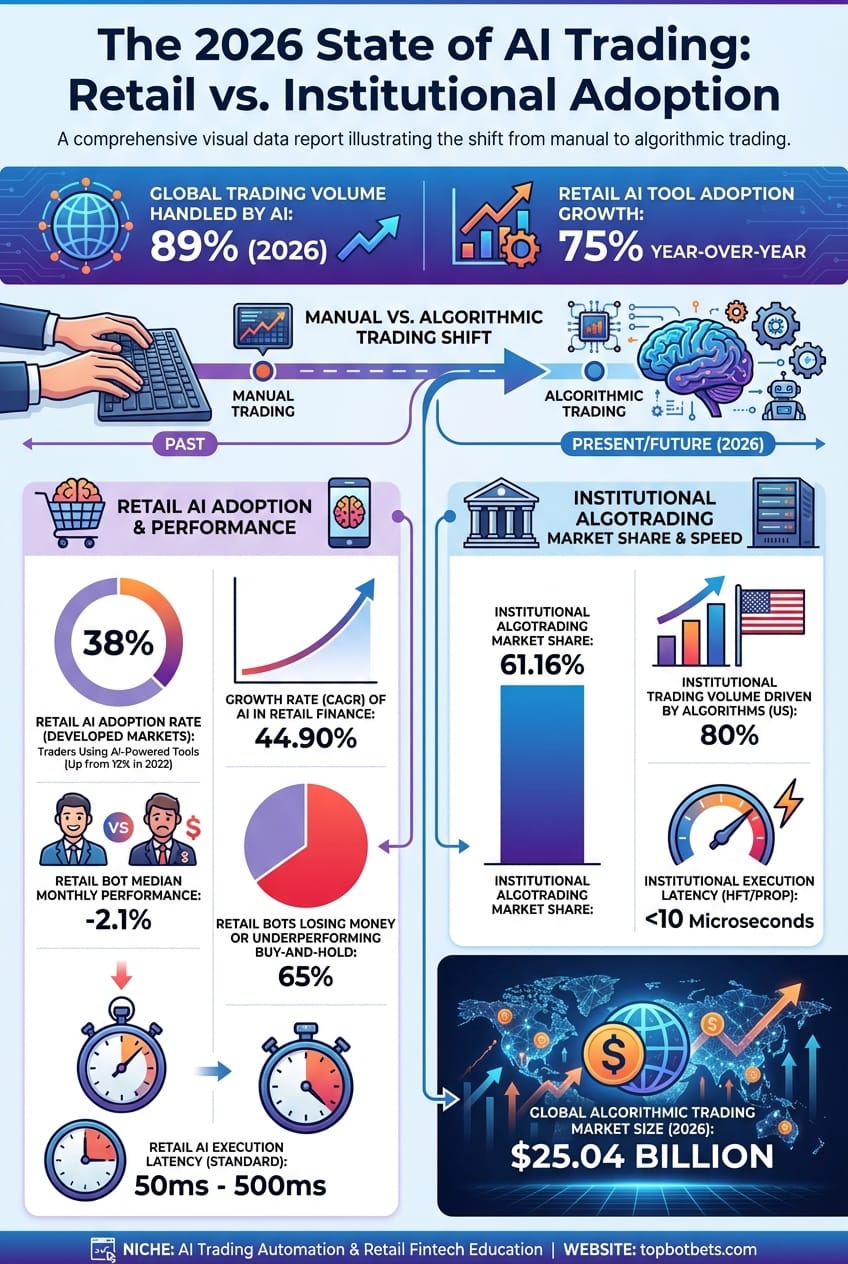
This infographic analyzes how AI-powered trading has grown across retail and institutional audiences in 2026, highlighting adoption rates, latency, market size, and performance signals. It contrasts accessibility and speed gaps that shape outcomes for everyday traders and professional desks
What the Data Reveals

The AI trading revolution is well underway but it’s not being experienced equally. In 2026, a striking divide separates retail traders from institutional players, and the latest data makes the gap impossible to ignore.
Retail AI Trading Adoption Is Surging But Still Lags Behind
Retail AI trading adoption in developed markets has climbed to 38% in 2026, a dramatic leap from just 12% in 2022. While this signals explosive growth in automated trading tools for everyday investors, institutional algorithmic trading still commands 61.16% of total market share. Professional trading desks, hedge funds, and investment banks continue to dominate the AI-powered trading landscape, armed with deeper capital, proprietary data pipelines, and infrastructure that retail platforms simply cannot replicate.
The Latency Gap: Microseconds vs. Milliseconds
One of the starkest contrasts in AI-driven trading is execution speed. Retail AI trading bots typically operate with latency ranging from 50 milliseconds to 500 milliseconds. Institutional high-frequency trading (HFT) systems, by contrast, execute orders in under 10 microseconds up to 50,000 times faster. In volatile markets, this speed advantage translates directly into profitability, allowing institutional algorithms to capitalise on arbitrage opportunities before retail systems can even register the signal.
A $25 Billion Market Powered by Automation
The global algorithmic trading market is valued at approximately $25.04 billion in 2026, reflecting the enormous appetite for AI-powered trade execution, quantitative strategies, and machine learning models in financial markets. Algorithms now drive roughly 80% of US trading volume, confirming that automation has become the backbone of modern market liquidity rather than a niche tool.
Retail Bot Performance: A Sobering Reality Check
Despite the enthusiasm around retail AI trading bots, performance data paints a cautionary picture. The median monthly return for retail bots sits at -2.1%, highlighting the challenges of translating AI hype into consistent profitability. Over-optimised strategies, poor risk management, and limited market access all contribute to underperformance. Retail traders exploring automated trading tools should approach back tested results with healthy scepticism and prioritise platforms with transparent, live-track records.
The Road Ahead: 44.90% CAGR in Retail AI Finance
The outlook for retail AI trading is nonetheless bullish. Forecasts project a 44.90% compound annual growth rate (CAGR) for AI in retail finance from 2026 to 2031, signalling rapid product maturation, increased accessibility, and wider adoption of algorithmic trading strategies among everyday investors. As AI trading platforms improve in sophistication and lower the barrier to entry, the gap between retail and institutional performance may gradually narrow though it won’t close overnight.

Key Takeaways
1. Retail AI adoption in developed markets reached 38% in 2026, up from 12% in 2022, signaling rapid growth but still trailing institutional usage.
2. Institutional algotrading accounts for 61.16% of the market share in 2026, underscoring the dominance of professional desks.
3. Retail AI execution latency typically ranges 50 ms to 500 ms versus institutional latency of under 10 microseconds for high-frequency strategies.
4. The global algorithmic trading market size in 2026 is about $25.04 billion, reflecting strong momentum and investment in automation.
5. Retail bot median monthly performance is -2.1%, highlighting challenges in retail bot performance relative to benchmarks.
6. Forecasts show a 46.54% CAGR for AI in retail finance from 2026 to 2031, indicating rapid expansion and tool maturation.
7. Algorithms drive roughly 80% of US trading volume in the 2023–2026 window, illustrating the shift toward automated execution across liquidity venue.
