
Why Smarter Traders in 2026 Are Combining Sentiment and Charts for a Bigger Edge
Hybrid AI trading systems that combine technical analysis, machine learning, and sentiment have hit returns of over 135% in live-like tests, showing how powerful sentiment-AI can be when it works alongside charts, not instead of them.
Key Takeaways
| Question | Answer |
|---|---|
| What is Sentiment-AI over Technical Analysis? | It is using AI to read news, social posts, and on-chain chatter, then layering those signals on top of traditional charts and indicators instead of relying on price action alone. |
| Can sentiment-AI help generate more consistent trading ideas? | Research suggests it can, especially when used with automation like the bots we discuss on our AI trading automation in 2026 guide, but results always depend on strategy and risk management. |
| Is this a way to Make money with AI without staring at charts? | Sentiment-driven bots can scan markets 24/7, which is why many traders use them as part of a more passive approach, similar to what we cover in investment bots for passive income. |
| Does Sentiment-AI replace technical analysis? | In 2026, the edge usually comes from combining both: sentiment for direction and timing, TA for entries, exits, and risk levels. |
| Is this financial advice? | No, this article is for education only and should never be treated as financial advice or a recommendation to trade. |
| How do crypto and stock bots use sentiment differently? | Crypto bots often lean harder on social sentiment and on-chain mood, which we compare in our crypto vs stock trading bots in 2026 breakdown. |
| Where do I start with AI bots that use sentiment? | We suggest beginning with simple automation and clear goals, like we outline on our AI investment bots & trading automation hub. |
What “Sentiment-AI over Technical Analysis” Really Means In 2026
When we talk about sentiment-AI over technical analysis, we mean putting AI-powered mood readings on top of traditional charts to guide decisions, not ignoring price patterns entirely.
In 2026, that usually means combining chart indicators like RSI or moving averages with AI models that read news, tweets, Reddit posts, and even funding-rate chatter in near real time.
Sentiment-AI vs classic chart-only trading
Classic technical analysis looks only at price and volume, which means it reacts to what already happened.
Sentiment-AI tries to read what traders are thinking and feeling before that mood fully shows up in the candles.
Why traders are shifting to hybrid approaches
Technical setups can be clean, but fake breakouts and stop hunts still catch many traders when crowd psychology flips unexpectedly.
Hybrid systems try to filter those traps by asking a simple question: “Does sentiment agree with what the chart is showing right now?”
How this fits into AI-driven passive strategies
For traders who want more passive income with AI, sentiment filters can act as on/off switches for bot strategies based on market mood.
Instead of manually checking fear and greed, the AI system can decide when to reduce exposure or pause high risk tactics when sentiment looks extreme.
How Sentiment-AI Actually Works On Top Of Charts
Under the hood, sentiment-AI models take unstructured text, convert it into numerical vectors, then map it to bullish, bearish, or neutral scores over time.
Those scores then sit beside your candles as extra data columns that bots and strategies can act on automatically.
Core sentiment inputs used in 2026
- News headlines and financial articles
- Twitter, Reddit, and other social feeds
- Exchange announcements and token updates
- On-chain alerts and funding-rate commentary for crypto
Each of these is noisy in isolation, but AI can aggregate thousands of messages and look for consistent direction and intensity.
From words to tradeable signals
Modern models like FinBERT and LLM-based classifiers score each text snippet, then aggregate scores into time windows like 5 minutes, 1 hour, or 1 day.
Your trading logic might then say, for example, “only enter long if 1 hour sentiment is positive and price is above the 50 MA.”Why this matters for Make money with AI tools
Most chart-only bots can be cloned by anyone, so edge often gets arbitraged away quickly.
Sentiment-AI adds proprietary flavor to AI content creation tools for strategies, since your exact sentiment feeds and rules are much harder to copy one-for-one
Research: Why Sentiment-AI Often Beats Chart-Only Models
In 2026 we are not guessing about sentiment-AI, there is a growing body of research that shows measurable gains when you combine it with technical analysis.
For example, a Sentiment-Augmented Random Forest model boosted average accuracy by 9.23 percent over conventional Random Forest and LSTM setups that looked only at price data.
Evidence from social media mood and indices
Work on Twitter mood showed that adding sentiment to price data increased predictive accuracy for Dow moves from 73.3 percent to 86.7 percent.
Reddit-based sentiment strategies have also beaten simple buy and hold in several backtests, especially in hype-driven markets.
Regime awareness and risk
Not all sentiment is positive for returns, some event-driven sentiment labels correlate with negative alpha and poor Sharpe ratios.
This is why we suggest treating sentiment as a probability modifier on top of TA, not as a blind trading trigger on its own.
Practical takeaway for traders in 2026
If you are already using bots and chart indicators, even a simple “avoid longs when sentiment is extremely negative” rule can change your risk profile.
That kind of guardrail can matter a lot if you are trying to use bots as one of several tools for passive income with AI into 2026 and beyond.
Did You Know?
Sentiment-Augmented Random Forest (SARF) improved average accuracy by 9.23% over conventional Random Forest and LSTM models for stock market prediction, highlighting the extra edge that sentiment signals can add on top of technical data.
Sentiment-AI For Crypto vs Stocks: Different Markets, Different Moods
Crypto and stocks both react to sentiment, but the way that mood flows into price is very different in 2026.
We see crypto reacting faster to Twitter and Reddit, while stocks often respond more to news headlines, earnings commentary, and macro narratives.Insights from crypto bot users
Crypto traders often use sentiment-AI to detect fear or greed spikes around specific coins or market cycles.
Research on extremity premiums in crypto shows that extreme sentiment regimes can predict higher spreads and different liquidity conditions across Ethereum and several other cycles.
Sentiment-AI in stock strategies
Stock traders are incorporating FinBERT-style sentiment scores into classical factor models to understand how mood affects short term returns.
These models suggest that sentiment can boost returns in normal regimes but may flip or amplify risk in extreme moments like crashes or mania phases.
What this means for your bot selection
When we walk through tools on our crypto vs stock bot guides, we look carefully at how each market handles sentiment, volatility, and liquidity.
If your goal is to Make money with AI tools in either arena, you need to match your sentiment filters to how quickly that market tends to react.
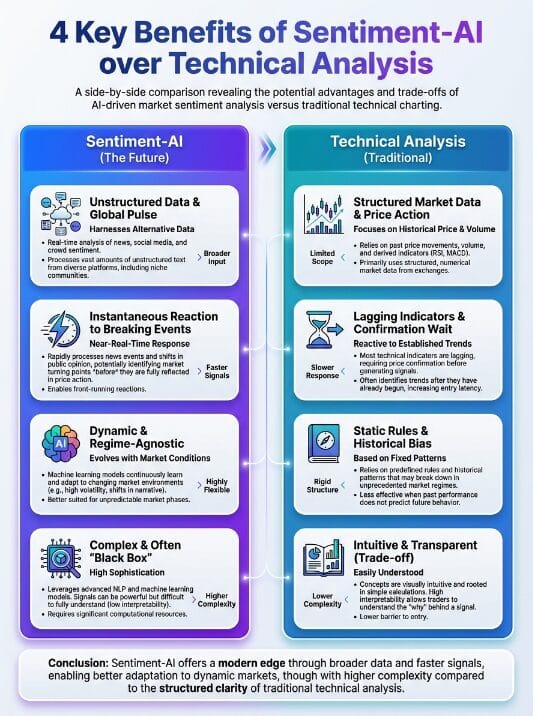
A concise visual guide to the four benefits of Sentiment-AI over Technical Analysis. See how sentiment-driven insights improve speed and accuracy in market analysis.
Designing Bot Rules: Where Sentiment Sits In Your Strategy Stack
From our perspective, sentiment-AI works best when you treat it as a filter or modifier on top of your main technical system.
This is how many traders structure rules that aim to generate income with AI while still controlling downside risk.
Typical hybrid rule structure
- Use TA to define trend and levels, for example moving averages and support or resistance.
- Use sentiment to adjust position size, entry timing, or whether to trade at all.
- Use automation to execute and monitor rules 24/7 across multiple markets.
This stack lets you separate “what the market is doing” (charts) from “what people feel about it” (sentiment).
Types of sentiment conditions traders use
We often see rules such as “skip breakout trades if crowd sentiment is extremely bullish” to avoid buying tops.
Others use “only scale into positions when sentiment shifts from negative to neutral” as a recovery indicator.
Why this can support more passive styles
Once your logic is coded, you do not need to manually watch news feeds and social timelines all day.
Your bot can pull, clean, and interpret sentiment data automatically, which is key if you want AI content creation tools for strategies that fit around a busy life and not the other way around.
Choosing AI Bots In 2026 That Actually Use Sentiment
Not every “AI trading bot” in 2026 uses real sentiment-AI, some just wrap basic technical indicators in marketing language.
When we review tools, we look for specific features that show the platform genuinely reads and processes external mood data.
Checklist for sentiment-capable bots
- Access to news, social, or on-chain data feeds in real time.
- Clear sentiment scores or labels you can plug into strategies.
- Backtesting support that includes those sentiment features.
- Risk controls that factor in sentiment extremes.
We also look at how transparent the platform is about its models and data sources, since “black box magic” is hard to trust.
Using guides and collections effectively
Our educational pages group tools by use case, such as crypto-focused bots, stock bots, and passive-income oriented bots.
Using those collections as a starting point can save you time when you are trying to Make money with AI tools without spending hours evaluating every option from scratch.
Remember the non-advice rule
None of this is financial advice, and using sentiment-AI does not guarantee profits or protect you from loss.
We always suggest starting small, testing thoroughly, and only risking capital you can afford to lose.
Bot Trading Advantages: Why Automation Suits Sentiment-AI
Sentiment changes quickly, and that is one reason automation fits so well with this style of trading in 2026.
Bots can scan, score, and react in seconds, while a human might still be reading the first few lines of a breaking headline.
Core automation advantages
- Consistent execution of rules without emotional hesitation.
- 24/7 monitoring of sentiment and price across many assets.
- Fast reactions to sentiment shocks that might trigger gaps or liquidations.
These strengths are particularly useful in crypto markets that never close and react instantly to sudden news.
Where humans still matter
Humans are still needed to design rules, choose assets, and decide how aggressive or conservative a strategy should be.
Automation handles the repetitive checking and execution, but it does not remove the need for judgment and risk awareness.
Fitting automation into your lifestyle
If your goal is more passive income with AI, then your role shifts from “manual trader” to “system designer and monitor.”
You focus on setting parameters and reviewing performance, then let your bots handle the grind of reading sentiment, placing trades, and managing positions.

Psychology, Personas, And Sentiment-Driven Mistakes
One of the biggest reasons sentiment-AI can help traders is that humans are often bad at judging their own emotions in real time.
Our AI trading persona work looks at how different trader types react under stress and how that matches up with market-wide mood swings in 2026.
Common sentiment-driven errors
- Chasing FOMO after reading a bullish thread or viral tweet.
- Panic selling during a temporary sentiment spike to the downside.
- Ignoring clear technical levels because “everyone says this time is different.”
Sentiment-AI can counter this by giving you objective numbers instead of raw emotional noise.
Aligning bots with your persona
If you know you tend to overreact to social media, you might deliberately design bots that fade extreme sentiment instead of following it.
Or, if you are too conservative, you might let bots take small, systematic bets on sentiment shifts you would normally ignore.
Education first, automation second
We always encourage traders to understand the psychology behind markets before handing decisions to bots.
Knowing how and why sentiment creates edges or traps makes you more likely to build sensible, sustainable strategies.
Did You Know?
Twitter mood data has been shown to boost predictive accuracy for Dow Jones moves from 73.3% using price data alone to 86.7% when sentiment is added, highlighting how crowd mood can materially improve short-term forecasts over pure technical analysis.
Risk Management When Using Sentiment-AI Signals
Sentiment edges can disappear fast, and they can flip direction suddenly, so risk management is critical in 2026.
We like to think of sentiment-AI as a “tilt” in your strategy, not a guarantee, especially in highly leveraged environments like crypto derivatives.
Key risk practices to consider
- Use position sizing rules that do not let sentiment alone dictate massive exposure.
- Set hard stop losses and maximum drawdown limits independent of mood scores.
- Test strategies across different sentiment regimes, not just bullish periods.
Some studies even show certain event labels in sentiment data lead to negative alpha, so blindly following all positive or negative signals can be dangerous.
Avoiding over fitting to mood data
Back tests that cherry pick the best performing sentiment rules from a small sample can look amazing on paper but fail live.
We suggest cross validating across time, assets, and different market regimes before committing real capital.
Accepting uncertainty
Even the best sentiment-AI plus technical analysis system will have losing periods and unexpected behavior.
Your job as a trader or investor is to decide what level of volatility and drawdown you are comfortable with before you start.
Building A Sentiment-First, Chart-Supported Strategy In 2026
If you want to experiment with sentiment-AI over technical analysis, you can start small with a simple, rule-based framework.
The idea is to let sentiment drive “when” you care most about the chart, instead of the other way around.
Example framework (for education only)
- Define your market and time frame, such as BTC on the 1 hour chart.
- Pick one or two technical indicators, such as trend and volatility measures.
- Pick one sentiment source with clear scoring, such as news or social sentiment.
- Write rules like “trade only when sentiment and trend agree” and “cut risk when sentiment is extreme.”
You can then back test this framework on historical data to see how it behaves under different conditions.
Using AI content creation tools to document strategies
Many traders now use general AI tools to write, refine, and document their trading plans clearly.
This habit can help you stay consistent and can make it easier to spot where sentiment rules are doing the heavy lifting versus where TA is more important.
Where passive income goals fit in
If your long term goal is more passive income with AI, start by aiming for robustness and simplicity rather than chasing maximum return.
In practice that usually means fewer rules, clear risk caps, and a strong focus on sustainability.
Conclusion
In 2026, the most competitive traders are not arguing about sentiment-AI versus technical analysis, they are asking how to combine both in a disciplined, automated way.
Sentiment-AI over technical analysis is less about replacing your charts and more about giving your bots a clearer read on the crowd, so you can pursue your own income goals with AI in a smarter, more informed way, always remembering that none of this is financial advice and that every trading decision carries risk.
