
AI Trading Automation: How People Really Use Bots To Make Money With AI (Without Sitting At The Screen All Day)
In 2026, around 60% of US equity trading volume is already handled by algorithmic systems, which shows how central AI trading automation has become in real markets, not just in theory.
Key Takeaways
| Question | Short Answer |
|---|---|
| What is AI trading automation in 2026? | It is the use of AI-powered rules and bots to analyze markets and place trades automatically, as explained in our guide on AI Investment Bots & Trading Automation. |
| Can AI trading bots help build passive income with AI? | They can support semi-passive income strategies if you use clear rules, risk controls, and regular monitoring, like we outline in Investment Bots For Passive Income. |
| Are crypto or stock trading bots better in 2026? | Each has different risks, fees, and volatility, which we compare in detail in Crypto vs Stock Trading Bots in 2026. |
| How do I choose a crypto AI trading bot safely? | Start from your goal, then check bot type, security, data, and risk settings, as covered in How to Choose the Best Crypto AI Trading Bot in 2026. |
| Where can I learn more about AI trading automation on our site? | Browse all our tutorials and breakdowns in the AI Trading Bots category. |
⚠️ Investment Disclaimer: This article is for education only and is not financial advice. Trading, including trading with AI trading bots, involves real risk and you can lose money.
1. What AI Trading Automation Really Means In 2026

When we talk about AI trading automation, we mean using software that can scan markets, follow predefined rules, and place trades for you, often 24/7. In 2026, these systems are accessible to everyday traders, not just hedge funds.
Most AI trading bots combine indicators, statistical models, and sometimes machine learning to decide when to buy or sell. The goal is to remove emotional decision making and apply the same logic to every trade.
In our AI Investment Bots & Trading Automation guide, we show how traders use bots to try to make money with AI while following structured risk rules. We always stress that no bot removes risk, it just changes how you manage it.
For many readers, AI trading automation is less about chasing huge gains and more about building a consistent, rules driven process that runs even when they are offline.
2. How AI Trading Bots Work Behind The Scenes
An AI trading bot connects to your broker or exchange through an API, reads live price and order data, then checks that data against your strategy rules. If the market meets those rules, it sends orders automatically.
Some systems use traditional indicators, like moving averages or RSI, while others use machine learning to detect patterns in price, volume, or order flow. In 2026, many retail platforms package this into simple templates that non coders can use.
We see three core pieces in almost every AI trading automation setup.
-
Signal engine that decides when conditions are right.
-
Execution engine that sends and manages orders.
-
Risk engine that controls position size and stop losses.
When you configure a bot, you are really configuring how these three engines work together. That is why we keep repeating that copying a random configuration without understanding the logic is risky.
3. Why Traders Use AI Trading Automation For Passive Income With AI
Many readers come to us asking how to build passive income with AI and trading bots, because they want market exposure without day trading manually. Automation can help you stick to a plan and avoid impulsive trades.
In our Investment Bots For Passive Income article, we explain that passive in this context usually means low maintenance, not zero work. You still need to monitor performance, adapt to market changes, and manage risk.
Some of the most common goals we see are:
-
To Make money with AI while keeping risk controlled.
-
To diversify existing long term portfolios with rules based trading.
-
To save time by automating routine entries and exits.
Robo advisors already manage around US$2.06 trillion in assets, which shows how mainstream automated market exposure has become. Retail bots are a more active extension of the same idea, with more control and more responsibility on the user.
Explore how AI Trading Automation can optimize trading decisions. This infographic highlights 5 key benefits.
Did You Know?
80% of buy-side traders say AI will have a significant effect in real-time algorithm optimization, which is exactly where AI trading automation tries to gain an edge.
4. Main Types Of AI Trading Bots In 2026
Not all AI trading bots work the same way. Choosing the right type is one of the most important steps before you connect real capital.
From what we see across platforms and user setups, most bots in 2026 fall into a few clear categories.
-
Trend following bots that ride medium term moves in crypto, forex, or stocks.
-
Mean reversion bots that fade short term spikes and dips.
-
Grid and DCA bots that place laddered buy and sell orders around a price range.
-
News or sentiment driven bots that use AI to parse text and social signals.

On our AI Trading Bots category page, we break down how these types behave across crypto, forex, and stocks. Different types will fit different ideas of passive income and risk.
For example, grid bots might suit users who want frequent small trades in sideways markets, while trend bots can fit traders who prefer fewer, larger swings. Matching bot type to your personality and time horizon is a bigger factor than many people expect.
5. Crypto AI Trading Bots vs Stock Trading Bots
One of the most common questions we get is whether crypto or stock AI trading bots are better for making money with AI. Our honest answer is that each path has trade offs, so the better fit depends on your situation.
In our detailed piece on Crypto vs Stock Trading Bots in 2026, we explain that both categories can support semi passive approaches, but they operate in very different environments.
| Aspect | Crypto AI Trading Bots | Stock AI Trading Bots |
|---|---|---|
| Trading hours | 24/7, higher overnight activity | Exchange hours, sometimes extended sessions |
| Volatility | Often higher, large moves common | More moderate for many tickers and ETFs |
| Regulation | Varies widely by jurisdiction and venue | Tighter, with clearer investor protections |
Crypto bots may suit traders who want constant action and are comfortable with rapid swings. Stock bots might appeal to users who prefer regulated venues and more predictable session structures.
Neither category guarantees profit, and in both cases you can lose part or all of your capital if markets move against your strategy.
6. How To Choose A Crypto AI Trading Bot In 2026
In 2026, crypto AI trading bots are everywhere, from centralized exchanges to third party platforms. That choice is useful, but it also creates real risk if you rush into the first marketing page you see.
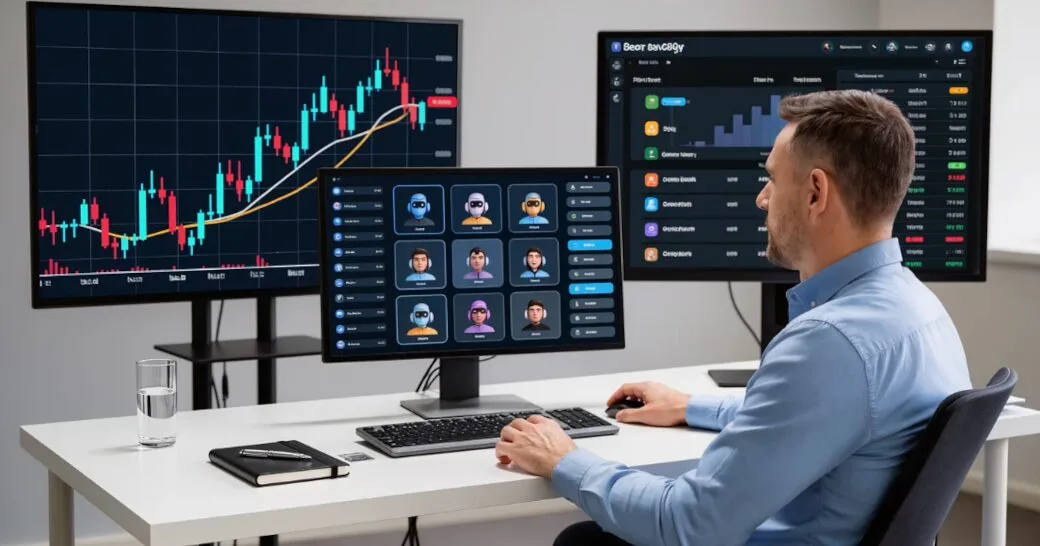
Our guide on How to Choose the Best Crypto AI Trading Bot in 2026 walks through the decision step by step, starting from your goal rather than the bot features.
-
Define your objective clearly, such as “Earn yield on stablecoins with low drawdowns” or “Trade swing moves on large cap coins.”
-
Match bot type to that objective, for example, grid bots for ranges or trend bots for breakouts.
-
Check security practices, API key permissions, withdrawal limits, and track record.
-
Test with paper trading or a very small allocation before scaling up.
Most crypto traders we speak to underestimate the impact of exchange fees and slippage on automated strategies. Even a good bot can struggle if costs eat too much of each trade.
7. Designing A Strategy To Make Money With AI Trading Bots Safely
A bot is only as good as the strategy behind it. If the logic is flawed, AI trading automation will simply apply that flawed logic faster and more consistently.
We focus heavily on strategy design in our core guides, because this is where traders can either build a thoughtful plan or accidentally set up a system that behaves like a slot machine.
When designing an AI supported strategy, we suggest you define in writing:
-
What market conditions you aim to trade and which you will ignore.
-
How much you are comfortable risking per trade and per week or month.
-
What your maximum acceptable drawdown is before you pause the bot.
In practice, this structure helps you treat AI trading automation like a small systematic business rather than a speculative hobby.
Did You Know?
The US algorithmic trading market was $12.5 billion in 2024 and is projected to reach $30.2 billion by 2034, highlighting how fast AI trading tools and automation are expanding across asset classes.
8. Backtesting, Paper Trading, And Validation Before Real Money
Backtesting and paper trading are where theory meets data. We encourage readers to treat this step as mandatory before they put meaningful money behind any AI trading automation setup.
Backtesting means running your rules on historical data to see how they would have performed. Paper trading means running the bot live with fake or tiny positions to test execution and slippage.
Here are key metrics we suggest watching in your tests:
-
Maximum drawdown, to check if the worst period is acceptable to you.
-
Win rate and payoff ratio, to understand the balance between winners and losers.
-
Number of trades, to estimate the impact of fees.
Remember that past performance does not guarantee future results, but poor backtest and paper trading results are usually a red flag you should not ignore.
9. Risk Management And Common AI Bot Mistakes
Risk management is where many traders either protect their capital or slowly drain it. AI trading bots can enforce risk rules, but only if you configure them carefully and avoid common mistakes.
One of the biggest issues we see is traders setting high leverage or wide position sizing early, because the system feels automated and detached from their personal savings.
Common mistakes we warn about include:
-
Running too many correlated bots on the same account.
-
Ignoring slippage and liquidity when backtesting thin markets.
-
Letting a bot run through major news events without a plan.
We also suggest you schedule regular reviews of performance, such as monthly or quarterly, and decide in advance what would make you pause or retire a bot.
10. Step By Step: Getting Started With AI Trading Automation Today
If you want to experiment with AI trading automation in 2026, you do not need to go all in on day one. You can treat it as a structured project, with clear stages and checkpoints.
Here is a simple path many of our readers follow when they start exploring how to Make money with AI trading bots while keeping risk in mind.
-
Clarify your goal and risk tolerance in one sentence.
-
Choose a market segment, such as large cap stocks, major forex pairs, or top crypto pairs.
-
Select a bot type that fits that goal instead of chasing every feature available.
-
Backtest, paper trade, and then start with a very small live allocation.
-
Review regularly and adjust or stop if performance diverges from expectations.
If you need help deciding what to research next, you can read more about our philosophy and content focus on the About TopBotBets page or reach out via our Contact page.
Conclusion
AI trading automation in 2026 is no longer science fiction. It is a practical toolkit that many traders use to structure their decisions, manage risk, and aim for semi passive income with AI in a disciplined way.
At the same time, bots do not remove risk and they do not guarantee that you will Make money with AI. They simply execute a plan that you design or select, so the real work is in choosing sound strategies, testing them properly, and managing your exposure with care.
This is not financial advice. Always research thoroughly and never invest more than you can afford to lose when using AI trading bots or any automated system.
